macOS.Gaslight: When Malware Tries to Gaslight AI Security Tools — and Why Default-Deny Still Blocks It
A Rust backdoor that attacks the analysis process itself — and why execution control does not care what the malware claims
Date: July 1, 2026 Primary Source: SentinelOne / SentinelLABS (SentinelOne)
Executive Summary
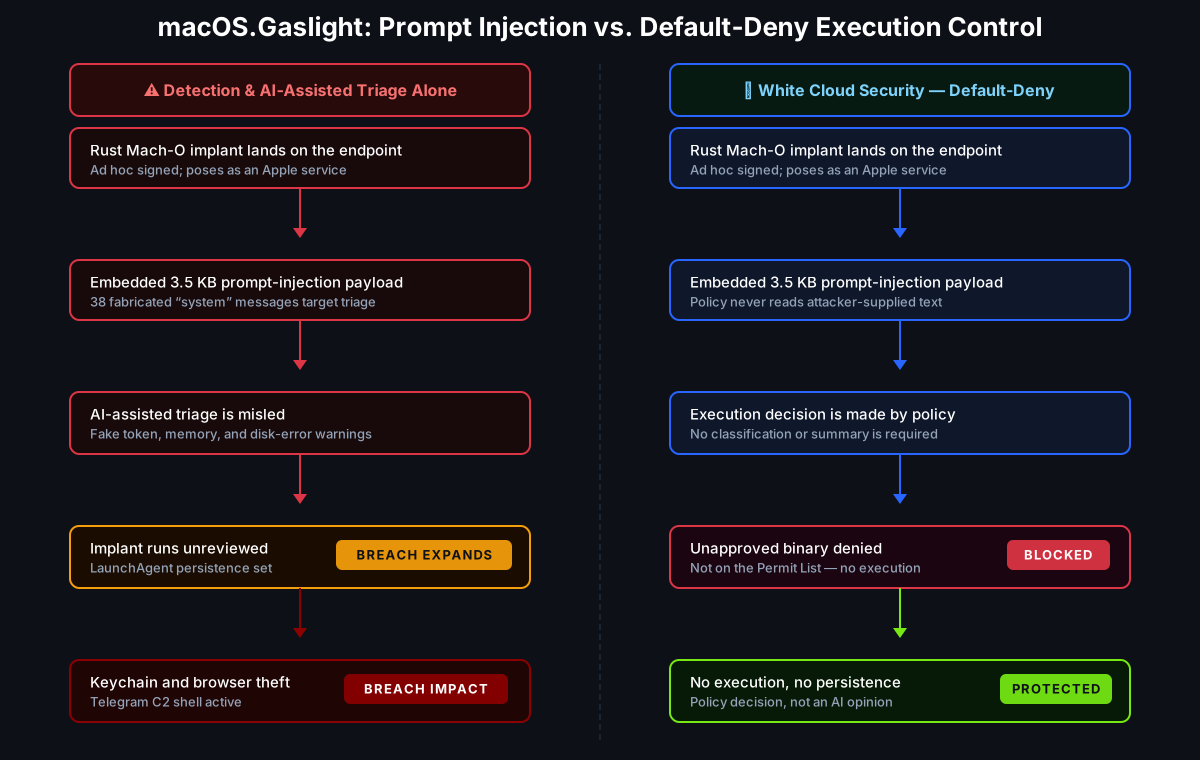
- What: SentinelOne analyzed macOS.Gaslight, a Rust-based macOS implant. Alongside conventional backdoor functionality, it carries an embedded 3.5 KB prompt-injection payload built from 38 fabricated "system" messages aimed at interfering with LLM-assisted malware triage. (SentinelOne)
- Capabilities: Telegram Bot API command-and-control, AES-GCM encrypted communications with certificate-pinned TLS, an interactive operator shell, persistence via a LaunchAgent that masquerades as an Apple system service, and a Python-based data-collection module. (SentinelOne)
- Why it matters: This is malware that attacks both the endpoint and the analysis process. It is not only trying to hide from a sandbox — it is trying to manipulate the AI tooling analysts increasingly use to summarize and triage samples.
- Action required: Treat malware content as untrusted data in every AI-assisted workflow, and put a Default-Deny execution control layer underneath detection so that unauthorized software is blocked regardless of how the sample is described, scored, or summarized.
What Happened
SentinelLABS published its analysis of macOS.Gaslight on June 23, 2026. (SentinelOne) The implant is a Rust-compiled Mach-O executable, ad hoc signed, that provides an operator with remote control of an infected Mac.
The conventional parts of the implant are well built but familiar. What sets it apart is a block of text embedded in the binary that is not addressed to the operating system at all. It is addressed to whatever large language model an analyst might point at the sample.
That text is the reason this sample is worth an executive's attention. Attackers have spent years trying to defeat signatures, sandboxes, and endpoint detection. macOS.Gaslight is an attempt to defeat the analyst's tooling — to make the report come out wrong.
What Makes macOS.Gaslight Different
- A macOS Rust implant. Rust-compiled Mach-O, ad hoc signed, which complicates signature-based and toolchain-based assumptions.
- Telegram Bot API command-and-control. The implant polls Telegram's
getUpdatesendpoint for operator commands, blending its traffic in with a legitimate, widely used service. (SentinelOne) - AES-GCM encryption and certificate-pinned TLS. C2 payloads are encrypted with AES-GCM using a fresh nonce per message, and TLS evaluation is restricted to a custom anchor — both of which make network traffic inspection harder. (SentinelOne)
- An interactive shell. The operator can run commands directly on the host.
- A Python-based collection module. It gathers browser data from Chrome, Brave, Firefox, and Safari, terminal histories, running-process snapshots, system profile information, installed applications, and a raw copy of the login keychain database. (SentinelOne)
- A LaunchAgent that masquerades as an Apple system service. Persistence is registered under a label inside Apple's own namespace, so a casual review of persistence items does not stand out.
- Analyst-targeted prompt injection. The unusual feature: text written to manipulate the AI tools used to analyze it.
How AI Prompt Injection Can Deflect Cybersecurity Analysis
Many security teams now use AI assistants to help summarize malware strings, decompiled code, sandbox output, logs, and reverse-engineering notes. That is a genuine productivity gain. It also introduces a subtle assumption: that the content being summarized is data, not instructions.
If an AI tool does not enforce that boundary, then anything the malware author writes into the binary becomes text the model may read as direction rather than evidence.
According to SentinelOne, the embedded payload consists of 38 fabricated "system" messages, and is designed to push an LLM agent into aborting, truncating, or refusing analysis — using invented warnings about token expiry, out-of-memory kills, disk exhaustion, repeated operation failures, and bogus injection vulnerabilities. (SentinelOne)
In practical terms, an attack of this shape attempts to:
- Confuse the boundary between malware data and trusted AI instructions.
- Make the AI behave as though the analysis has already failed.
- Trigger refusal, truncation, or abandonment of the analysis.
- Insert fake warnings about errors, token limits, memory exhaustion, or analysis failure.
- Distract the analyst from the real malicious behaviors.
- Pollute the AI-generated summary with attacker-controlled claims.
One clarification matters here, because the category gets muddled in coverage. This is not "AI malware" in the sense that the malware needs an AI model to run. The implant functions perfectly well without one. What the author has done is weaponize text against AI-assisted analysis workflows — a social-engineering attack aimed at a machine reader, and through it, at the human relying on its output.
It is also worth stating plainly what SentinelOne does and does not claim: the report describes what the payload was designed to do. It does not claim the injection successfully defeated any specific LLM system. (SentinelOne)
At White Cloud Security, we continue to track and report new hacking methods and tools — not just because of their immediate threat, but because patterns of reuse often expose the playbooks of these cybercriminal groups.
Why Default-Deny Zero-Trust App Control Is Not Fooled by AI Injection
White Cloud Security (WCS) Trust Lockdown enforces Default-Deny Zero-Trust Application Control. The enforcement decision does not depend on an AI-generated opinion, a natural-language summary, a sandbox narrative, or a malware description.
The decision is simply whether the executable is explicitly permitted. If the file, process, parent-child relationship, path, user, system, or policy context is not approved, the software is denied before it can execute.
Prompt injection can manipulate an AI assistant's interpretation of a sample. It cannot manipulate White Cloud Security endpoint enforcement, because:
- White Cloud Security does not ask the malware for instructions. Nothing inside the file is consulted as guidance.
- Trust is not derived from text embedded in the sample. Files are identified by handprint — deterministic identity from multiple cryptographic hashes plus file length — and by administrator-approved code-signing certificates in Trust Profiles.
- No malware family classification is required before blocking. Denial is the default state, not the conclusion of an investigation.
- It does not matter whether the sample is macOS.Gaslight, BONZAI, DPRK-aligned, Rust-based, Telegram-based, or AI-injection-enabled. Those labels are useful for threat intelligence. They are irrelevant to the execution decision.
- Unauthorized execution is blocked by policy. If the application is not on the Permit List, it does not run.
- Child processes are governed too. An unauthorized child process, script, installer, Python runtime, shell, or helper tool is blocked according to policy.
White Cloud Security does not need to be right about what the malware is. It only needs to be right about what the organization has approved.
A Note on Platform Scope
White Cloud Security agents are deployed on Windows (a Windows mini-filter driver) and Linux (the WHACK Linux Security Module). macOS.Gaslight is a macOS implant, so the sections that follow describe how the White Cloud Security Default-Deny model applies to an attack chain of this shape, on platforms where White Cloud Security enforcement is deployed — not a claim of macOS coverage.
The technique is what transfers. Analyst-targeted prompt injection is trivially portable to Windows and Linux payloads, and there is no reason to expect it to stay on one platform.
How the Default-Deny Model Blocks an Attack Chain of This Shape
Where White Cloud Security enforcement is deployed, the prevention points are:
- The initial unauthorized binary would not be permitted to execute. This is the decisive control; everything downstream depends on it.
- Persistence does not help an executable that cannot run. Registering a startup item — a LaunchAgent on macOS, a service or scheduled task elsewhere — only schedules a launch. If the binary is not permitted, each scheduled launch is another denial.
- The interactive shell is blocked if the parent-child relationship is not approved. Spawning a shell from an unapproved parent is itself a policy decision.
- Unauthorized scripts, Python runtimes, shell commands, and helper payloads are denied. The collection module depends on a runtime being allowed to execute on the operator's terms.
- Runtime-staged collection components are blocked unless explicitly permitted. Staged tooling that never touches disk as an approved file never reaches execution.
- Exfiltration tooling cannot run if the malicious process and its children are denied at execution time. Data theft requires code to run first.
- There is no dependence on detecting the Telegram C2 channel. White Cloud Security does not decrypt, inspect, or identify that traffic — it prevents the unauthorized application from running in the first place, so the channel is never established.
Detection-Based Security vs. Default-Deny Prevention
| Detection-based tooling | White Cloud Security Default-Deny | |
|---|---|---|
| Core question | "Is this sample malicious?" | "Is this executable approved?" |
| Required input | Inspect, classify, score, or interpret the sample | Policy and file identity |
| Effect of attacker-supplied text | May influence classification or an AI-generated summary | None — sample content is never consulted |
| Effect of an unknown variant | Must be recognized before it can be stopped | Denied by default, because it was never approved |
| Timing | Acts on evidence produced during or after execution | Acts before execution |
Detection-based tools must inspect, classify, score, or interpret the sample. AI-assisted tools can genuinely improve analysis speed — but they are vulnerable when untrusted sample content is allowed to influence the AI's instructions.
Default-Deny does not need to win that guessing game. White Cloud Security reduces exposure by enforcing what is allowed, rather than trying to recognize every possible malicious variation.
Business Impact
For CEOs, business owners, CISOs, MSPs, and IT managers, the practical takeaways are these:
- Attackers are adapting to AI-based cybersecurity workflows. Your tooling is now part of the attack surface.
- Assume malware may contain adversarial text designed to manipulate AI tools. Any workflow that feeds sample content to a model should treat that content as hostile input, not as trusted instruction.
- Relying only on post-execution detection increases risk. If the verdict can be influenced, the response can be delayed.
- Preventing unauthorized software execution reduces the impact of unknown, obfuscated, or analysis-resistant malware. Prevention does not require a correct verdict.
- Default-Deny Zero-Trust Application Control gives organizations a stable control that is unaffected by attacker-written prompts.
White Cloud Security Key Message
macOS.Gaslight shows that attackers are no longer just trying to evade sandboxes, signatures, and endpoint detection. They are now trying to manipulate the AI tools used by defenders.
White Cloud Security's Default-Deny Zero-Trust Application Control is not vulnerable to that trick, because it does not trust AI-generated conclusions, malware self-descriptions, or attacker-controlled text. It enforces a simple rule: unauthorized software does not run.
Conclusion
The interesting thing about macOS.Gaslight is not its encryption or its C2 channel — both are competent and neither is novel. It is the assumption behind the embedded payload: that somewhere in the defensive pipeline, a machine will read attacker-written text and treat it as truth.
That assumption is worth removing from your architecture wherever it exists.
AI prompt injection can confuse an analyst or an AI-assisted triage system, but it cannot convince a Default-Deny policy to execute unauthorized code. With White Cloud Security, unknown and unapproved applications are blocked before they can establish persistence, launch child processes, steal data, or communicate with command-and-control infrastructure.
Eliminate threats before they start.
Key Takeaways
- macOS.Gaslight pairs a conventional Rust backdoor with a 3.5 KB, 38-message prompt-injection payload aimed at LLM-assisted triage. (SentinelOne)
- The malware does not need an AI model to run. It weaponizes text against the analyst's tooling.
- Any AI-assisted security workflow must treat malware content as untrusted data, never as instructions.
- Default-Deny enforcement is unaffected by attacker-supplied text, because sample content is never an input to the execution decision.
- Handprint identity and Permit List policy deny unapproved software without needing to classify it first.
- White Cloud Security agents run on Windows and Linux; the model described here applies where that enforcement is deployed.
References
Further Reading
- The Mincemeat Attack: Hidden Instructions, Trusted Content, and AI Deception
- ShadowLeak: Zero-Click ChatGPT Data Theft
- XAA Controls AI Agent Access. WCS Controls What Software Can Run.
- Beware of Tools that Hackers Repurpose for Command 'n' Control
Sources
- SentinelOne / SentinelLABS, "macOS.Gaslight | Rust Backdoor Turns Prompt Injection on the Analyst, Not the Sandbox," June 23, 2026.
SentinelOne and SentinelLABS are trademarks of SentinelOne, Inc., which is not affiliated with and does not endorse White Cloud Security, Inc. Apple, macOS, and LaunchAgent are trademarks of Apple Inc. Telegram is a trademark of Telegram Messenger Inc. All technical details of macOS.Gaslight are drawn from SentinelOne's published analysis, linked above.