Microsoft Defender RoguePlanet Zero-Day: When SYSTEM Privileges Are Not Enough to Bypass White Cloud Security
A trusted security component becomes a privilege-escalation path — but SYSTEM access still does not make unauthorized software permitted to run
Date: June 17, 2026 Primary Sources: SecurityWeek · Help Net Security · The Hacker News · Morphisec
Executive Summary
- What: RoguePlanet (CVE-2026-50656) is a local privilege-escalation zero-day in Microsoft Defender / the Microsoft Malware Protection Engine (
MsMpEng.exe) that can elevate a local attacker or already-running process to NT AUTHORITY\SYSTEM. - Who is affected: Fully patched Windows 10 and Windows 11 systems. A public exploit has been released; Microsoft has confirmed the flaw and says a patch is in development.
- Severity: High — CVSS 7.8 (local, low complexity, no user interaction required).
- Action required: Apply Microsoft's update as soon as it ships — and reduce the blast radius now with Default-Deny application control so SYSTEM access cannot be turned into successful malware execution.
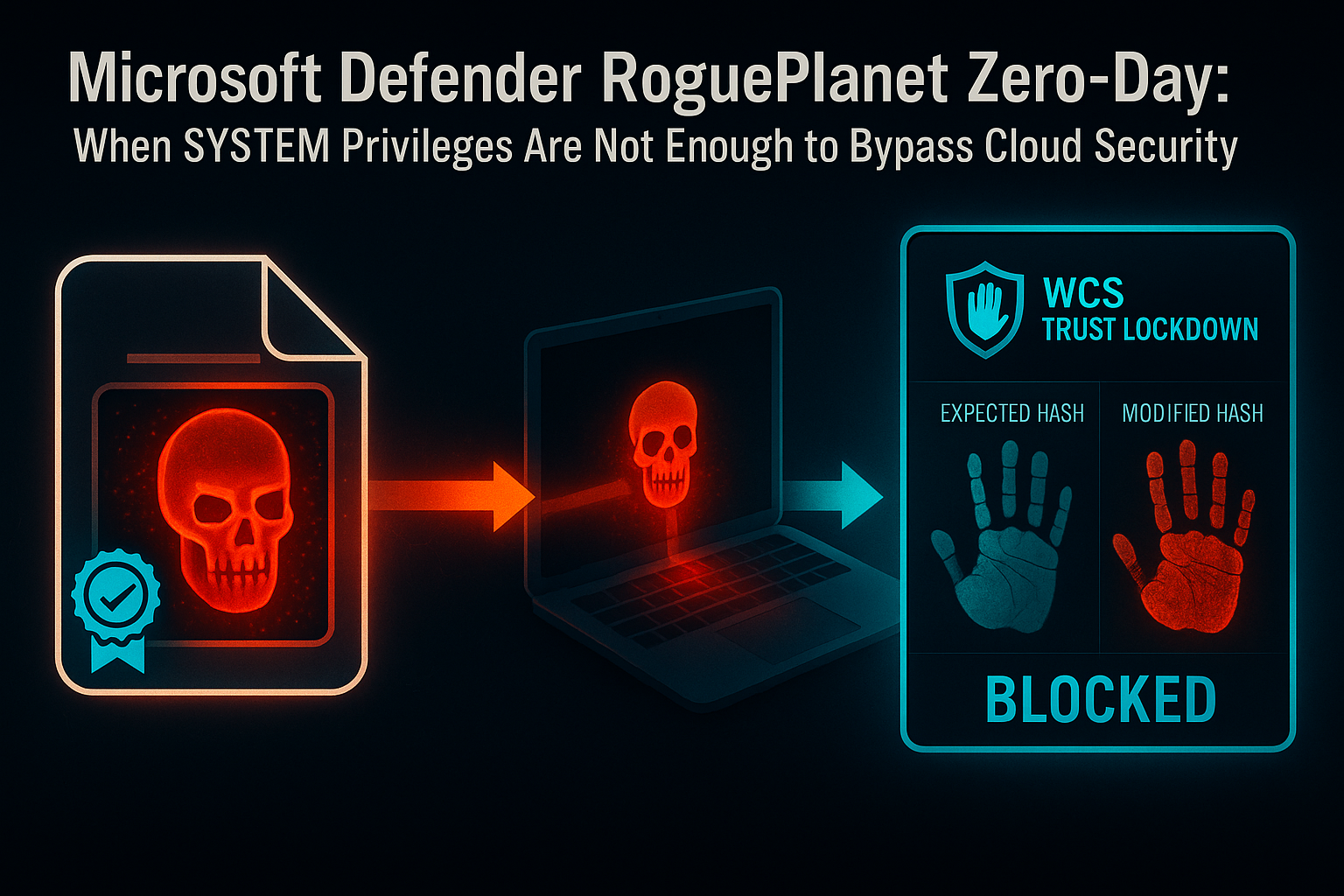
The danger of RoguePlanet is not simply that it grants SYSTEM. The danger is what an attacker does after reaching SYSTEM: launch a payload, run ransomware, deploy a credential stealer, install persistence, or disable defenses. White Cloud Security (WCS) changes that outcome by enforcing whether software is permitted to execute — regardless of the privilege context it runs under.
Overview
In June 2026, a Microsoft Defender zero-day named RoguePlanet was publicly disclosed, tracked as CVE-2026-50656. Public reporting describes it as a race-condition flaw in Defender's file-processing path (MsMpEng.exe) that abuses the engine's trusted remediation behavior to spawn a SYSTEM-level shell — a local privilege escalation on devices that are otherwise fully updated. (SecurityWeek) (Help Net Security)
The exploit was published by a researcher operating under a pseudonym, and Microsoft confirmed the issue on June 17, 2026, stating that a patch is in development without committing to a date. (The Hacker News) Security researchers have characterized the core risk plainly: when a trusted security component itself becomes part of the attack path, detection-only strategies are on weaker ground. (Morphisec)
This post intentionally avoids procedural exploit details. The important question for defenders is not how the race condition is won — it is what happens next, and how to make sure SYSTEM-level access does not automatically translate into running unauthorized software.
Threat Summary
| Field | Detail |
|---|---|
| CVE ID | CVE-2026-50656 ("RoguePlanet") |
| CVSS Score | 7.8 (High) |
| Affected component | Microsoft Defender / Microsoft Malware Protection Engine (MsMpEng.exe) |
| Affected products | Fully patched Windows 10 and Windows 11 |
| Vulnerability class | Race condition / improper link resolution (TOCTOU) → local privilege escalation |
| Attack vector | Local; low complexity; no user interaction; authenticated |
| Impact | Elevation to NT AUTHORITY\SYSTEM |
| Exploited in the wild | Public exploit released; abuse risk elevated |
| Patch available | No — Microsoft confirmed; patch in development (as of June 17, 2026) |
Technical Analysis
How the Attack Works
At a high level — and without operational detail — RoguePlanet abuses a timing (race-condition) weakness in how Defender processes files during its trusted remediation/quarantine activity, allowing a low-privileged process to gain SYSTEM. (SecurityWeek) (Morphisec) The security significance is the after stage, which follows a familiar pattern:
- Initial foothold or local execution. An attacker already has some ability to run code on the endpoint (e.g., a phishing payload, a malicious script, or a prior compromise) (MITRE ATT&CK T1059).
- Privilege escalation. RoguePlanet-style abuse of Defender elevates that context to SYSTEM (T1068).
- Execution attempt. The SYSTEM-level process attempts to launch the next tool or payload (T1106).
- Damage. Ransomware, credential theft, persistence, remote-access tooling, defense tampering, or lateral-movement utilities (T1486, T1003, T1547, T1219, T1562).
- Business impact. Data loss, downtime, stolen secrets, and a wider breach.
Attack Chain
Initial foothold / local code execution
      ↓
RoguePlanet-style privilege escalation (CVE-2026-50656)
      ↓
SYSTEM-level process attempts to launch tools or payloads
      ↓
Ransomware / credential theft / persistence / lateral movement
      ↓
Business impact
Payload and Impact
RoguePlanet itself is an escalation primitive, not a payload — its value to an attacker is the SYSTEM context it unlocks. With SYSTEM, an attacker can attempt to load unauthorized tools, run ransomware, deploy credential stealers, install persistence, run remote-access tooling, disable or tamper with defenses, execute lateral-movement utilities, and stage additional malware. Every one of those steps requires running software — which is exactly the step WCS governs.
Why Traditional Defenses Struggle
- A trusted component is the ladder. Defender is normally a trusted security product; when it is abused, detection strategies that assume "trusted = safe" are weakened. (Morphisec)
- SYSTEM is assumed safe. Many controls implicitly trust SYSTEM-level and signed-Windows-component activity, so malicious actions launched from that context can blend in.
- No patch yet. With a fix still in development, signature- and patch-dependent defenses leave a window open. (Help Net Security)
- Admin or SYSTEM does not equal safe. Privilege level says who is running something — not whether that something should run at all.
RoguePlanet vs. RedSun: A Pattern, Not a Coincidence
RoguePlanet is not the same exploit as RedSun, and the two should not be conflated. They are separate Defender-related vulnerabilities — RedSun targets CVE-2026-33825 (patched April 2026), while RoguePlanet is CVE-2026-50656 (patch in development). WCS previously analyzed RedSun.
What they share is the architectural lesson: attackers increasingly target trusted platform and security components to gain privilege. Both reinforce the same principle — trust should be based on explicit authorization of software identity, not on process reputation or privilege level. A control that asks "is this exact software permitted here?" holds up across both incidents, and across the next one.
How White Cloud Security Trust Lockdown Stops This
Traditional defenses often assume that trusted Windows components and SYSTEM-level activity are inherently safe. WCS does not rely on privilege level. WCS Trust Lockdown enforces a Default-Deny, Zero-Trust Application Control policy based on approved software identity. If a binary, script, tool, payload, or child process is not explicitly Permitted, it is blocked from executing — even when the launch attempt comes from a SYSTEM-level process or a trusted Windows component.
Even if an attacker reaches SYSTEM, WCS still asks the key zero-trust question: "Is this specific software allowed to run here?" If the answer is no, it is denied.
Mapping the Post-Escalation Stage to WCS Controls
| After SYSTEM is obtained, the attacker tries to… | WCS result |
|---|---|
| Launch an unknown executable | Denied — not on the permit-list |
| Run an unauthorized script or script interpreter | Denied unless that exact use is permitted by policy |
| Drop and execute a ransomware payload | Denied before encryption can begin |
| Run a credential-theft tool | Denied — unauthorized tooling does not execute |
| Launch a remote-access tool not on the permit-list | Denied |
| Rename or relocate malware to evade name/path rules | Denied — identity does not match permitted software |
| Spawn a child process from a trusted parent | Evaluated by policy, not blindly trusted |
Handprint Identity
WCS identifies permitted applications by handprint — deterministic identity from multiple cryptographic and file attributes (SHA-1, SHA-256, SHA-512, MD5, CRC32, and file length) — plus admin-approved code-signing certificates in Trust Profiles. That is why renamed, relocated, or rebuilt malware is still denied: a SYSTEM-level launch does not change the file's identity, and an unknown identity is not Permitted. This is how WCS helps Eliminate Threats BEFORE They Start.
At White Cloud Security, we continue to track and report new hacking methods and tools — not just because of their immediate threat, but because patterns of reuse often expose the playbooks of these cybercriminal groups.
To be precise about scope: WCS does not patch RoguePlanet, does not prevent Microsoft Defender from containing the vulnerability, and does not claim to stop every privilege-escalation condition at the vulnerability layer. What WCS does is reduce the attacker's ability to turn SYSTEM privileges into successful malware execution — SYSTEM is powerful, but it does not make unknown software authorized under a properly enforced Default-Deny policy.
Example Scenario
A user workstation is exposed to RoguePlanet after an initial compromise. The attacker wins the race condition, obtains SYSTEM, and attempts to launch a malicious payload.
- On an unprotected machine: that payload may run with the highest privileges — encrypting files, stealing credentials, or installing persistence.
- On a WCS-protected machine: the payload is not on the permit-list, so execution is denied before the malware can do any of that. The attacker holds SYSTEM, but SYSTEM does not authorize unknown software to run.
Why This Matters for SMBs and Regulated Organizations
- Reduces the blast radius of zero-days like RoguePlanet, where no patch is yet available.
- Protects endpoints when patching is not immediate — coverage does not depend on a fix shipping first.
- Limits abuse of legitimate Windows components by governing execution, not reputation.
- Enforces governance over exactly what software may run on business endpoints.
- Reduces dependency on detection after a compromise has already begun.
Recommended Mitigations
- Apply Microsoft's security update for CVE-2026-50656 as soon as it is available, and review Microsoft Defender guidance. (Help Net Security)
- Monitor for abnormal privilege escalation and SYSTEM-spawned child processes.
- Remove unnecessary local admin rights to shrink the initial-foothold surface.
- Deploy Default-Deny application control and verify that only approved software is permitted on business endpoints.
- Use WCS Trust Lockdown in Block Mode to prevent unauthorized payload execution regardless of privilege context.
Note on indicators: RoguePlanet is a privilege-escalation exploit (publicly released by the pseudonymous "Nightmare Eclipse"), not a malware family with stable file hashes or C2 infrastructure. There are no reliable payload IOCs to publish; defense should focus on patching and execution control rather than indicator matching. (The Hacker News)
Key Takeaways
- SYSTEM is not safety. RoguePlanet's real risk is the unauthorized software an attacker runs after escalation.
- Trusted components can be abused. RoguePlanet and RedSun both turn Defender into part of the attack path — authorize software, don't trust privilege.
- Default-Deny holds under SYSTEM. WCS asks "is this exact software permitted here?" and denies if not — even for SYSTEM-level launches.
- Patch and prevent. WCS does not replace Microsoft's patch; it reduces the blast radius while you wait and beyond.
References
- SecurityWeek — Microsoft Working on Patch for 'RoguePlanet' Zero-Day
- Help Net Security — Microsoft working on patch for RoguePlanet Defender zero-day (CVE-2026-50656)
- The Hacker News — Microsoft Defender RoguePlanet Zero-Day Grants SYSTEM Access on Updated Windows
- Morphisec — Microsoft Defender Zero Day RoguePlanet: When Your Detector Becomes the Attack Surface