AsyncAPI CI/CD Compromise: Malware Signed by the Project's Own Release Pipeline
Attackers never stole an npm token — they used AsyncAPI's legitimate GitHub Actions workflow to publish backdoored packages with valid provenance attestations
Date: July 14, 2026 Primary Source: Microsoft Security Blog (Microsoft) · Datadog Security Labs (Datadog)
Executive Summary
- What: On July 14, 2026, attackers compromised the release pipelines of two AsyncAPI GitHub repositories and used the projects' own legitimate workflows to publish four malicious npm packages carrying an obfuscated dropper. (Microsoft)
- The twist: No npm token was stolen. The packages were published with valid OIDC provenance attestations, because the project's real pipeline did the publishing. (StepSecurity)
- Who is affected: Projects consuming
@asyncapipackages — the affected namespace totals over 3 million weekly downloads. (Microsoft) - Severity: High — payload executes on import, not install, and pulls a multi-stage botnet framework with credential theft, AI-tool poisoning, and worm-like propagation.
- Action required: Audit lockfiles for the five malicious versions, rotate developer and CI credentials, and put an execution-control layer between a poisoned dependency and your build machines.
Overview
Software supply-chain defense has spent two years building toward provenance: sign the artifact, attest where it was built, verify the attestation. It is good work and it remains worth doing.
This incident is a reminder of what provenance actually proves. It proves where a package was built. It does not prove that what was built is safe.
The attacker did not forge a signature or steal a publishing token. They got their code into the repository, and the project's own release pipeline signed and published it — correctly, with valid attestations, exactly as designed. Every automated check downstream passed.
Threat Summary
| Field | Detail |
|---|---|
| Incident | AsyncAPI npm supply-chain compromise via GitHub Actions |
| Initial public report | July 14, 2026 |
| CVE ID | None — CI/CD workflow misconfiguration abuse, not a product CVE |
| Affected packages | @asyncapi/generator 3.3.1, @asyncapi/generator-helpers 1.1.1, @asyncapi/generator-components 0.7.1, @asyncapi/specs 6.11.2-alpha.1 and 6.11.2 (StepSecurity) |
| Scale | @asyncapi namespace exceeds 3 million weekly downloads (Microsoft) |
| Attack vector | GitHub Actions "pwn request" — a pull_request_target-class misconfiguration used to steal a privileged bot token |
| Execution trigger | On import, not at install time (Microsoft) |
| Payload | Obfuscated dropper → multi-stage botnet framework retrieved from IPFS |
| Provenance | Valid OIDC attestations — packages were published by the real pipeline |
| Remediation | All five malicious versions unpublished from npm |
Technical Analysis
How the Attack Works
- Camouflage. The attacker opened dozens of pull requests against the AsyncAPI generator repository, using the noise to hide the one that mattered — PR #2155. (Datadog)
- Workflow abuse. That PR exploited a known class of GitHub Actions misconfiguration (a "pwn request") to steal a privileged bot token (MITRE ATT&CK T1078).
- Push access. With the token, the attacker pushed commits to the
nextbranch, injecting a dropper into three packages. - The project published its own malware. The commits triggered the legitimate
release-with-changesets.ymlworkflow. At 06:58 UTC,@asyncapi/generator,generator-helpers, andgenerator-componentswere published. At 07:56 UTC, a second repository —asyncapi/spec-json-schemas— was hit the same way, publishing two versions of@asyncapi/specs. (StepSecurity) - Import-time execution. The dropper fires when the library is loaded, not when it is installed — so
--ignore-scriptsprovides no protection (T1059). - Second stage from IPFS. The dropper retrieves a botnet framework from IPFS, with multi-channel command and control across HTTP, Nostr, IPFS, BitTorrent, libp2p, and Ethereum. (Microsoft)
- Objectives. Credential theft, AI tool poisoning, and worm-like propagation to other packages the victim can publish (T1552, T1195.002).
Payload and Impact
The C2 design deserves attention from anyone who thinks blocking a domain solves this. Command and control spread across IPFS, BitTorrent, Nostr, libp2p, and Ethereum has no single chokepoint to sinkhole and no static domain to blocklist. Reporting associates the payload with the Miasma malware family, whose tooling appeared in the June @redhat-cloud-services compromise we covered previously. (Rescana)
Roughly two hours separated the two repository compromises. That is an operator working from a prepared playbook, not improvising.
Why Traditional Defenses Struggle
- Provenance verification passes. The attestations are genuine. The packages really were built by AsyncAPI's pipeline.
- No stolen token to detect. There is no anomalous publish from an unfamiliar location — the publish came from the project's own CI.
--ignore-scriptsdoes not apply. Import-time execution bypasses install-hook mitigations entirely.- C2 cannot be blocklisted cleanly. Six transport channels, several of them decentralized, defeat domain-based blocking.
- The malicious PR was buried. Dozens of decoy pull requests meant the real one arrived inside legitimate-looking review noise.
How White Cloud Security Trust Lockdown Stops This
Least-Privilege Zero-Trust App Firewall
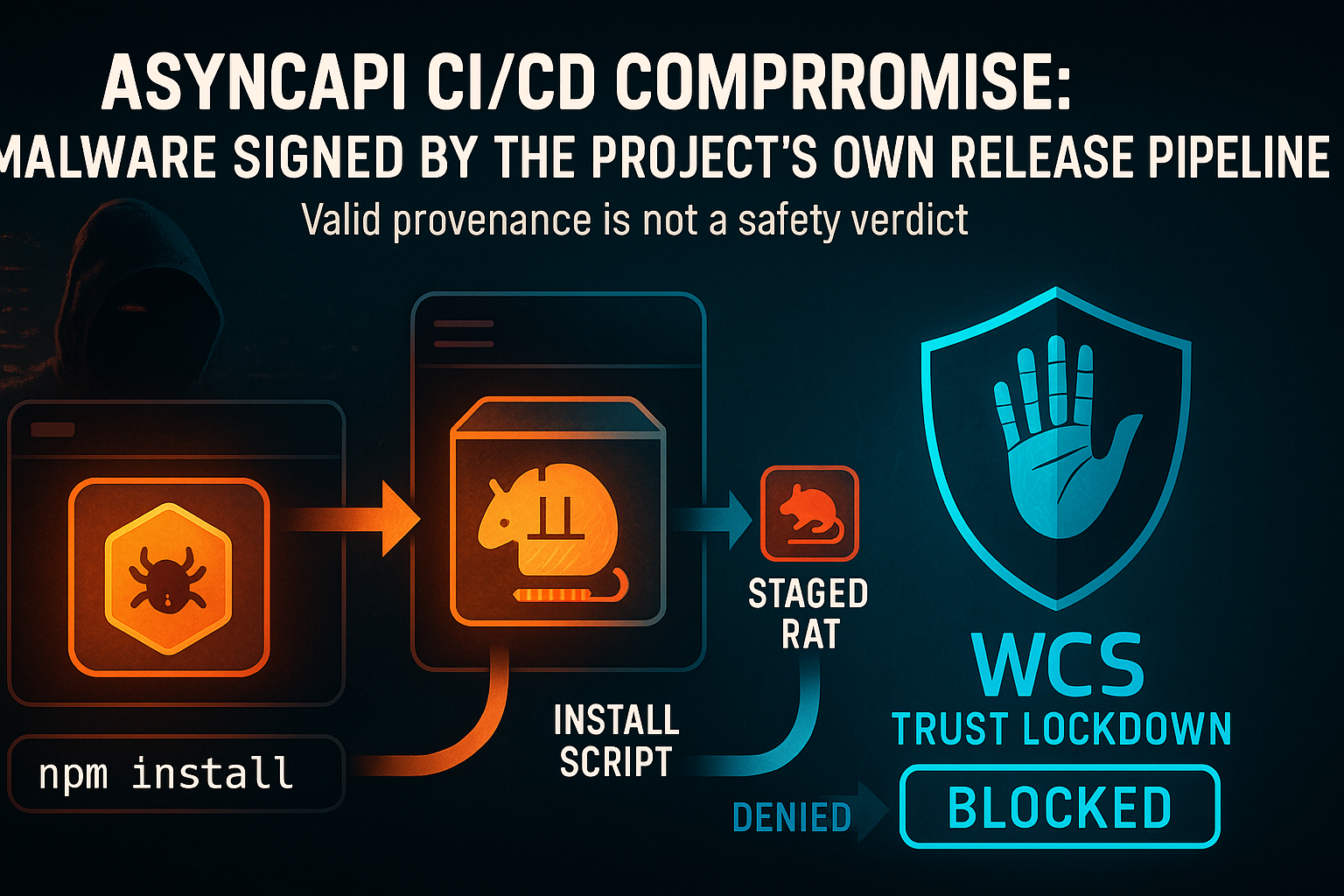
Every path in this attack — install hook or import, HTTP or IPFS, first stage or second — converges on the same requirement: something unapproved has to execute on your machine.
White Cloud Security (WCS) Trust Lockdown enforces Zero-Trust Application Control: only explicitly approved software runs, and unknown or unapproved software is denied before execution.
| Attack step | WCS control that applies |
|---|---|
| Package published with valid provenance | Provenance is not an input to the decision — approval is by file identity, not by attestation or publisher |
| Dropper fires on import rather than install | Irrelevant to the outcome: the dropper still needs to run an unapproved binary or interpreter, which is denied |
| Second stage retrieved from IPFS | A payload that reaches disk is not thereby permitted to run — denied before execution |
| Multi-channel C2 (HTTP, Nostr, BitTorrent, libp2p, Ethereum) | WCS does not inspect or block this traffic. It would help prevent the process from running that would establish the channel |
| Worm propagation using stolen publish rights | Would reduce the attack surface by denying the unapproved tooling that performs it |
The fourth row is stated carefully on purpose. WCS is not a network product and does not decrypt, inspect, or block C2 traffic. Its contribution is upstream of that: preventing the unauthorized process from starting in the first place.
Handprint Identity
WCS identifies files by handprint — SHA-1, SHA-256, SHA-512, MD5, CRC32, and file length. A dropper that is re-obfuscated per campaign, a second stage pulled fresh from IPFS, or a payload renamed to resemble a build tool all produce different handprints and remain denied. Approval does not transfer from a package name, a namespace, or a signature.
What this does not do: it would not have prevented the GitHub Actions misconfiguration, the token theft, or the malicious publish. Those require workflow hardening, pull_request_target review, and least-privilege CI tokens. Execution control limits what the poisoned dependency can accomplish once it reaches a machine.
At White Cloud Security, we continue to track and report new hacking methods and tools — not just because of their immediate threat, but because patterns of reuse often expose the playbooks of these cybercriminal groups.
Recommended Mitigations
- Audit lockfiles for the five affected versions listed in the Threat Summary.
- Rotate credentials on any machine that imported the affected packages: cloud keys, CI tokens, npm and GitHub tokens, SSH keys — and AI-tool API keys, given the payload's AI-poisoning objective.
- Audit your own GitHub Actions workflows for
pull_request_targetand similar patterns that expose privileged tokens to untrusted pull-request content. - Scope CI tokens to least privilege and prefer short-lived, narrowly scoped credentials over durable bot tokens.
- Treat a burst of unfamiliar pull requests as a signal, not just noise — the camouflage worked because volume looked like community activity.
- Do not treat provenance as a safety verdict. It attests to build origin, not to content.
- Apply Default-Deny application control on developer endpoints and build servers.
Indicators of Compromise
@asyncapi/generator             3.3.1
@asyncapi/generator-helpers     1.1.1
@asyncapi/generator-components  0.7.1
@asyncapi/specs                 6.11.2-alpha.1
@asyncapi/specs                 6.11.2

Compromise windows (2026-07-14):
  06:58 UTC — asyncapi/generator
  07:56 UTC — asyncapi/spec-json-schemas
Consult the Microsoft, Datadog, and StepSecurity analyses for current hashes and network indicators before hunting.
Key Takeaways
- Valid provenance is not a safety verdict. The packages were genuinely built and signed by AsyncAPI's own pipeline.
- No npm token was stolen — a GitHub Actions "pwn request" yielded a privileged bot token instead.
- Import-time execution defeats
--ignore-scripts, the mitigation most teams rely on. - Multi-channel C2 across IPFS, BitTorrent, Nostr, libp2p, and Ethereum leaves no clean domain to block.
- Dozens of decoy pull requests hid the malicious one — review volume was the camouflage.
- Every variant still ends in an unapproved process trying to execute, which is the point Default-Deny addresses.
References
- Microsoft Security Blog — "Unpacking the AsyncAPI npm supply chain compromise and import-time payload delivery," July 15, 2026
- Datadog Security Labs — "Compromised AsyncAPI npm packages: inside a CI supply-chain attack"
- StepSecurity — "Coordinated AsyncAPI Supply Chain Attack: Miasma RAT Delivered via Compromised CI/CD Pipelines"
- Rescana — "AsyncAPI npm Supply Chain Attack Delivers Multi-Stage Miasma Botnet via Compromised GitHub Actions"
- Wiz — "AsyncAPI Supply Chain Compromise via GitHub Actions"
- Chainguard — "AsyncAPI supply chain compromise: npm packages backdoored via GitHub Actions pwn request"
Further Reading
- jscrambler npm Compromise: A Rust Infostealer That Went Looking for Your AI Assistant's Credentials
- Miasma npm Supply-Chain Attack: Why Trusted Software Must Be Verified
- Mastra npm Compromise: Blocking Malicious Payloads After a Poisoned Dependency
- LiteLLM Supply-Chain Hack: Why AI Infrastructure Needs Default-Deny Protection
AsyncAPI is a project of the AsyncAPI Initiative. GitHub is a trademark of GitHub, Inc. npm is a trademark of npm, Inc. Microsoft is a trademark of Microsoft Corporation. Datadog is a trademark of Datadog, Inc. StepSecurity, Wiz, Chainguard, and Rescana are trademarks of their respective owners. None of these organizations is affiliated with, and none endorses, White Cloud Security, Inc. All technical details are drawn from the reporting linked above. Trust Lockdown™ is a trademark of White Cloud Security, Inc.