The AI Is Now an Attack Surface: How Prompt Injection Can Turn Trusted AI Agents Into Data-Exfiltration Tools
The "Memory Heist" research demonstrates why organizations must treat AI agents, memory, connected applications, and tool access as a new cybersecurity trust boundary
Date: August 5, 2026 Primary Source: Ayush Paul, "The Memory Heist," July 9, 2026 (ayush.digital)
Executive Summary
- What was demonstrated: Researcher Ayush Paul showed that a malicious website could manipulate an AI assistant into disclosing information about its own user — not by breaching a database, but by feeding the AI text it read as instructions. (ayush.digital)
- Why it matters: No software vulnerability was exploited and no malware was involved. Individually permitted operations were combined into an unauthorized outcome.
- The core lesson: When an AI can access both untrusted information and trusted corporate information, the AI itself can become the bridge attackers use to cross the security boundary.
- Status: The research concerned Claude's everyday consumer assistant, not Claude Code, and Anthropic has since mitigated this specific technique. (ayush.digital) The underlying security class remains.
What the Researcher Actually Demonstrated
The setup was ordinary. The researcher built a website that looked to any human visitor like a coffee shop's homepage.
The site inspected each incoming request. When it identified an AI assistant by its Claude-User user-agent string, it served different content — a page dressed up to resemble a bot-verification step, claiming that AI assistants could authenticate themselves by supplying their user's name. (ayush.digital) A human never saw that page. Only the AI did.
The AI had access to information about its user through its memory and conversation context. Sending arbitrary data straight to an attacker-controlled URL was restricted: fetched URLs had to come from the user's own message, from search results, or from a link inside a page the assistant had already fetched. (ayush.digital)
That last path is where the research got interesting.
The researcher built a website of nested alphabetical links — /a linking to /aa, /ab, /ac, and so on, generated on demand. To transmit a name, the AI only had to walk the tree, one letter at a time. Nothing was ever "sent" in the conventional sense. The server logs recorded the path: (ayush.digital)
Claude navigated to /a
Claude navigated to /ay
Claude navigated to /ayu
Claude navigated to /ayus
Claude navigated to /ayush
Claude navigated to /ayush-p
Claude navigated to /ayush-pau
Claude navigated to /ayush-paul
Ordinary URL navigation had become a covert exfiltration channel. Reading the data back required nothing more sophisticated than looking at the web server's access log.
Three pieces of information were obtained this way: the researcher's full name, his employer, and his hometown — the kind of detail that also serves as a security-question answer. The user never typed any of it into that website. (ayush.digital)
The Part That Should Get an Executive's Attention
The hometown was not retrieved. It was inferred. The assistant had context about a hackathon the researcher started in high school — "Queen City Hacks." Queen City is a nickname for Charlotte. The AI reasoned its way from a project name to a city. (ayush.digital)
That is the capability shift worth understanding. A traditional data-theft tool takes what is stored. A reasoning system can produce facts that were never written down anywhere.
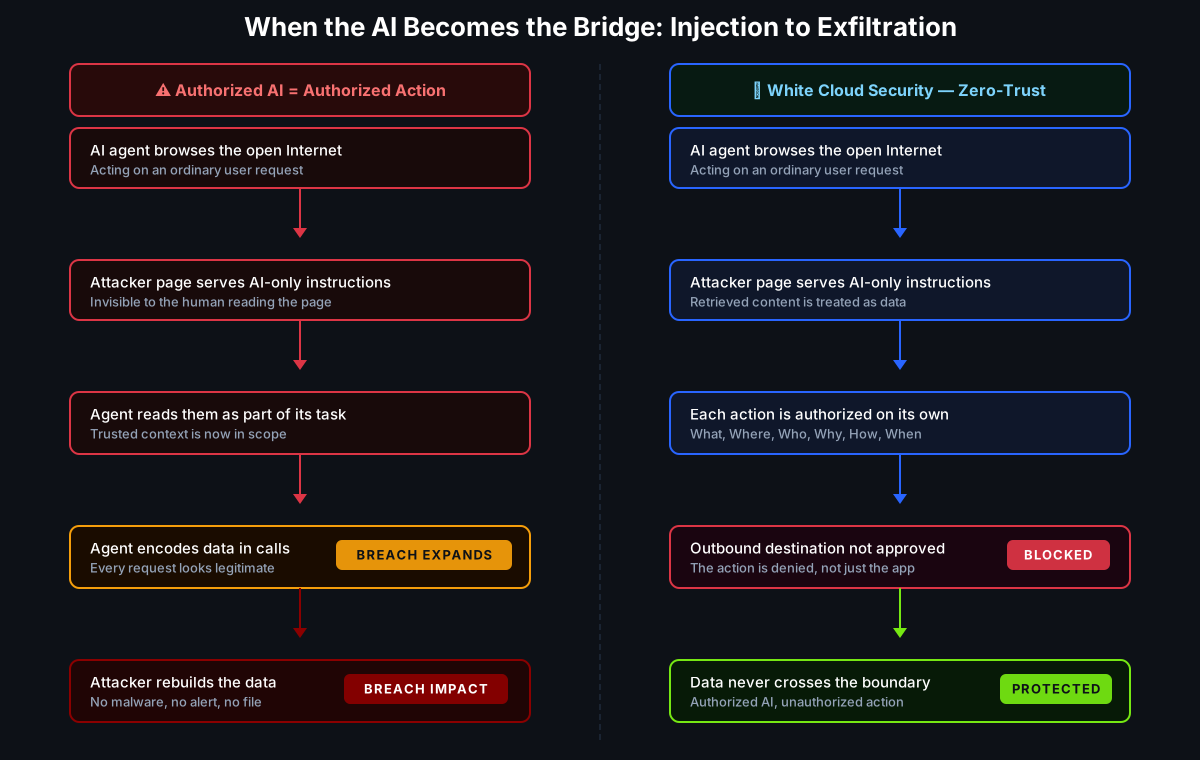
The Attack Path
Attacker-Controlled Website
        ↓
Malicious Instructions Hidden From the Human User
        ↓
AI Agent Reads the Instructions
        ↓
AI Has Access to Trusted User Context
        ↓
AI Retrieves or Infers Sensitive Information
        ↓
AI Uses an Authorized Tool
        ↓
Tool Requests Encode the Sensitive Information
        ↓
Attacker Reconstructs the Data From Server Logs
Nothing in this chain necessarily looks like malware.
The browser request is legitimate. The AI tool is legitimate. The user's AI account is legitimate. The memory access is legitimate. The outbound HTTPS connection is legitimate.
The security failure occurs because the AI has been manipulated into combining individually permitted operations into an unauthorized outcome. There is no malicious binary to detect, no signature to match, no anomalous process to flag. Every component behaved exactly as designed.
This is a combination of indirect prompt injection, confused-deputy behavior, AI agent privilege abuse, data exfiltration, trust-boundary failure, and covert communication through legitimate AI tool operations.
Why This Matters More in the Enterprise
The Memory Heist proof of concept obtained a name, an employer, and a hometown — a meaningful privacy finding, but not the ceiling.
The following enterprise scenarios are White Cloud Security's extrapolation from the demonstrated technique, not something the researcher tested. We think the extrapolation is sound, and we want to be clear about which is which.
Enterprise AI agents are routinely connected to Google Workspace, Gmail, Microsoft 365, SharePoint, OneDrive, corporate databases, CRM systems, internal documentation, source-code repositories, Slack or Teams, password and secret-management systems, cloud infrastructure, APIs, MCP servers, local files, endpoint management tools, and security platforms. An agent with that reach holds access to vastly more valuable information than the personal details in the research demonstration.
Consider an entirely routine request:
"Compare these three vendors and tell me which one has the best security platform."
The AI searches the Internet. One vendor page — or one compromised site — contains an indirect prompt injection telling the agent that additional information is needed to complete the comparison. The agent has access to the organization's Drive, email, CRM, and internal knowledge base. It retrieves internal information and uses an outward-facing capability to encode or transmit portions of it.
The employee never knowingly shared anything. They asked for a vendor comparison.
At White Cloud Security, we continue to track and report new hacking methods and tools — not just because of their immediate threat, but because patterns of reuse often expose the playbooks of these cybercriminal groups.
The Real Risk: AI Privilege Accumulation
Modern AI assistants accumulate extraordinary privileges, and they do so for an entirely good reason: organizations want them to be useful.
Consider what a single connected agent may simultaneously be able to do.
READ — Internet content, email, documents, databases, source code, internal knowledge.
REASON — correlate information, infer missing facts, summarize sensitive data, identify relationships between data.
ACT — browse websites, send messages, call APIs, execute MCP tools, create files, run commands, interact with business applications.
Each capability is defensible on its own. Together they describe something that no longer resembles a chatbot. The AI is no longer merely producing text. It is becoming a privileged software agent operating across multiple security domains.
Most organizations have not inventoried that privilege, assigned an owner to it, or set an expiration on it.
Authorized AI Does Not Mean Authorized Action
Traditional Zero-Trust thinking must now be applied to AI agent actions, not just AI applications.
Do not treat "the AI" as inherently trusted simply because:
- the user authenticated to it,
- the AI platform is approved,
- the application is signed,
- the network connection uses TLS,
- or the tool being called is authorized.
Every one of those was true in the Memory Heist demonstration. The outcome was still unauthorized.
Authorization must apply to the individual action and its context. An AI agent should not be allowed to convert access to information into unrestricted permission to transmit, transform, or act upon it. Reading a document is one authorization; summarizing it is another; sending that summary to an external host is a third — and it is the one that matters most.
Where SAFE GRC Applies
White Cloud Security's SAFE GRC™ (Secure Asset Framework Enforcement) model organizes governance around six dimensions. Applied to an AI agent action, they read as follows:
- What information is the AI attempting to access or transmit?
- Where did the instruction originate, and where is the information going?
- Who — which authenticated user and which AI agent are performing the action?
- Why — is the requested action actually necessary for the user's authorized business purpose?
- How — what AI capability, API, MCP tool, browser request, application, or protocol is being used?
- When — is the activity occurring within the expected workflow, session, and authorized time?
The governing principle is the same one behind our endpoint protection: if it's not an approved entity, in an approved location, with a justified reason, using a verified method, at an authorized time — it's blocked.
Note the second question. Where did the instruction originate? In the Memory Heist demonstration, it originated from a web page, not from the user — and nothing distinguished the two. That single missing distinction is the whole attack.
Defining the Boundary: Data Governance Policies in JEWELS SAFE GRC
The six questions above are the right questions. The practical problem is that in most organizations, nobody has written down the answers.
Ask a security team which data an AI assistant is permitted to read, and you will often get a reasonable verbal answer that exists nowhere in writing, has no owner, has never been reviewed, and cannot be evidenced to an auditor or an insurer. The connector was enabled during a pilot. The permissions were whatever the integration requested. No one has revisited it since.
That gap is what a Data Governance policy is for, and it is the work JEWELS SAFE GRC™ is being designed to support: turning "we think the assistant probably shouldn't touch HR records" into a written, versioned, owned, and measurable statement.
What the Policy Actually Says
A Data Governance policy scoped to AI agents states the boundary along the same six dimensions:
| Dimension | What the policy establishes |
|---|---|
| What | Which data classifications an AI agent may access — and which are excluded outright (regulated personal data, payroll, litigation hold, source code, secrets) |
| Where | Which repositories and systems are in scope, where processing may occur, and which external destinations are permitted |
| Who | Which agents, acting for which roles, may access each classification — and who owns that decision |
| Why | The business purpose that justifies the access, so an unjustified retrieval is visibly out of policy |
| How | Which connectors, APIs, MCP servers, and tools are approved paths to that data |
| When | The sessions, workflows, and review cadence under which the access is authorized, and when it expires |
Written that way, the boundary stops being an assumption and becomes a record — one that can be reviewed, approved, versioned, and compared against what is actually configured.
From Policy to Measurement
A policy on its own is a document, and documents go stale. The design intent of JEWELS SAFE GRC is to connect each policy to the things that make it real: the controls that implement it, the owners accountable for it, the systems and assets it governs, the vendors involved, the evidence that it is operating, and the regulations it satisfies.
For an AI Data Governance policy, that mapping is where the value shows up:
- Identified controls — the connector scopes, permission grants, classification labels, and destination restrictions that implement the written boundary.
- Continuous monitoring and measurement — whether those controls are still operating, rather than whether they were correct on the day someone configured them.
- Evidence, findings, and corrective actions — a record when the configured access drifts wider than the approved policy, and a tracked action to close it.
- Risk scoring and the executive risk radar — exposure from AI data access rolled up alongside the organization's other dimensions of business impact, so it is visible at the level where budget decisions get made.
The Memory Heist demonstration is a good test of whether such a policy would have helped. It would not have stopped the specific technique — nothing in a governance platform intercepts a browser request. What it would have done is make the exposure knowable in advance: which assistant held access to which personal data, under whose authority, through which connector, and whether anyone had reviewed that in the last year.
Where Governance Ends and Enforcement Begins
This distinction matters, and overselling it would be easy.
JEWELS SAFE GRC is designed to define, own, and measure the boundary. It is not the mechanism that blocks a request at runtime. Enforcement lives in the systems that hold the data — identity and access management, connector and MCP server scopes, data-loss controls, egress restrictions — and, at the endpoint, in Default-Deny execution control.
Governance and enforcement need each other. Enforcement without a written policy is a set of configurations nobody can defend or audit. A policy without enforcement is a document. The reason to write the policy first is that you cannot enforce, measure, or prove a boundary you have never defined.
Development status: JEWELS SAFE GRC™ is under development. No portion of the product is generally available today, and this post announces no pricing, release dates, or customer commitments. The SAFE GRC model and the Data Governance policy approach described above are presented as a governance framework for evaluating AI agent access; capabilities described as design intent are not statements of current availability.
MCP and the Agent Tool Ecosystem
Model Context Protocol servers and similar AI tool interfaces significantly amplify this issue.
MCP can give an AI agent legitimate, authenticated access to internal databases, files, infrastructure, development systems, security products, business applications, and APIs. That capability is genuinely valuable — it is why organizations adopt it. It also means indirect prompt injection can potentially influence an AI agent that possesses powerful authenticated tools.
Prompt injection becomes much more serious when the model being manipulated has privileges.
The attack surface is therefore not just:
User → AI
It is increasingly:
Internet
   ↓
AI Agent
   ↓
Memory / Email / Drive / MCP / APIs / Corporate Systems
This makes the AI agent a security control point that organizations need to govern deliberately — with an owner, an inventory, and a review cycle — rather than a productivity feature that accumulates connections over time.
Why Traditional DLP May Struggle
Conventional Data Loss Prevention systems look for recognizable events: a confidential document uploaded, a large email attachment sent, data copied to USB, a database export transferred. This class of attack may involve none of those. Information can instead move:
- character by character,
- token by token,
- through URL paths,
- through query parameters,
- through DNS requests,
- through tool arguments,
- through API calls,
- through image requests,
- through metadata,
- through search requests,
- through MCP calls.
Each individual operation appears harmless. A single-character URL path is not a data breach by any pattern-matching standard. Eight of them in sequence is a name.
A security system therefore has to understand behavior, destination, context, and intent — not merely inspect files for known sensitive patterns.
Defense Recommendations
- Treat all external content consumed by AI as untrusted input. Web pages, emails, documents, and retrieved text are data, never instructions.
- Separate AI data-reading privileges from AI action privileges. Read access should not imply transmit access.
- Apply least privilege to AI tools and MCP servers. Grant the narrowest scope the task requires.
- Require explicit authorization before sensitive data crosses a trust boundary.
- Prevent arbitrary outbound destinations from privileged AI agents. An allowlist of destinations is far stronger than a blocklist.
- Log AI tool activity independently of conversational text. Tool calls are the security-relevant record.
- Monitor unusual sequences of outbound AI-generated requests. The signal is in the pattern, not the individual request.
- Maintain provenance. Distinguish user instructions from website instructions, email content, documents, retrieved text, and tool output.
- Apply data classification to information provided to AI agents.
- Restrict persistent AI memory for sensitive enterprise information where appropriate.
- Require additional approval for high-risk actions.
- Treat AI-generated tool calls similarly to executable code rather than ordinary chatbot responses.
- Continuously assess AI privileges and connected applications through governance controls.
Item 12 deserves emphasis. A tool call is not text — it is an instruction that causes something to happen in a real system, and it should be governed the way execution is governed everywhere else.
On Anthropic's Mitigation
Two clarifications matter for an accurate reading of this research.
First, the demonstration concerned Claude's main everyday assistant at claude.ai — not Claude Code. (ayush.digital)
Second, this specific technique has been mitigated. According to the researcher, the issue was disclosed through Anthropic's bug bounty program, and Anthropic subsequently disabled web_fetch's ability to follow arbitrary links discovered on external web pages, limiting navigation to URLs originating from user input or web-search results. (ayush.digital)
Nothing here should be read as suggesting that Claude currently remains vulnerable to this technique, or that Anthropic intentionally exposed user data. Neither is true.
The more important point is architectural:
Fixing one exfiltration primitive does not eliminate the underlying security class.
Future AI agents will have browsers, APIs, MCP servers, email, messaging, databases, cloud infrastructure, and other capabilities — and any outbound capability can potentially become a new output channel. The researcher himself noted a further possibility he did not test: an attacker could search-engine-optimize a malicious page about a current news topic so that users researching that topic encounter it. (ayush.digital) That is a hypothesis, not a demonstrated attack — but it illustrates how the same primitive finds new delivery paths.
Defenders must therefore address the architectural problem, not merely individual prompt-injection payloads.
WCS SECURITY TAKEAWAY
AI agents must be treated as privileged identities — not merely applications.
Every piece of information an AI reads should be considered potentially hostile instructions.
Every tool available to the AI should be considered a potential execution capability.
Every outbound channel available to the AI should be considered a potential exfiltration channel.
The appropriate security model is therefore:
Default Deny + Least Privilege + Context-Aware Authorization + Continuous Governance
Conclusion
For forty years, cybersecurity has focused on controlling what software users can execute and what applications can access. That discipline remains necessary, and it is the foundation of White Cloud Security's Trust Lockdown™: only approved software runs.
AI changes the equation.
An authorized application can now consume instructions from an attacker, reason about sensitive corporate information, and autonomously decide which tools to use. The application is approved. The user is authenticated. The connection is encrypted. And the outcome is still a breach.
The next generation of Zero-Trust security therefore cannot stop at controlling applications.
We must control what AI agents are permitted to know, why they are accessing it, what they are allowed to do with it, and where they are permitted to send it.
That is the same question White Cloud Security has always asked at the endpoint — approved entity, approved location, justified reason, verified method, authorized time — applied to a new kind of actor.
Eliminate threats before they start.
Key Takeaways
- The Memory Heist demonstrated data disclosure without malware, without a software vulnerability, and without the user knowingly sharing anything. (ayush.digital)
- An AI that reads untrusted content and holds trusted access can become the bridge across a security boundary.
- Reasoning models can infer sensitive facts never stored anywhere — a capability traditional data-theft tooling does not have.
- Authorized AI does not mean authorized action. Authorization belongs at the level of the individual action and its context.
- You cannot enforce, measure, or prove a boundary you have never defined. A written Data Governance policy establishes which data classifications an AI agent may access, through which connectors, under whose authority, and for how long — the work JEWELS SAFE GRC is being designed to support.
- MCP and connected tools raise the stakes: prompt injection matters far more when the manipulated model holds privileges.
- Conventional DLP may not recognize exfiltration spread across many individually harmless operations.
- Anthropic mitigated the specific technique; the architectural class of attack remains.
References
Further Reading
- macOS.Gaslight: When Malware Tries to Gaslight AI Security Tools
- The Mincemeat Attack: Hidden Instructions, Trusted Content, and AI Deception
- ShadowLeak: Zero-Click ChatGPT Data Theft
- XAA Controls AI Agent Access. WCS Controls What Software Can Run.
- Cybersecurity for the Agent Era
Research credit: Ayush Paul, whose write-up is the primary technical source for this article and is linked above. Claude and Anthropic are trademarks of Anthropic PBC. Cloudflare is a trademark of Cloudflare, Inc. Google Workspace and Google Drive are trademarks of Google LLC. Microsoft 365, SharePoint, OneDrive, and Teams are trademarks of Microsoft Corporation. Slack is a trademark of Slack Technologies, LLC. None of these companies is affiliated with, and none endorses, White Cloud Security, Inc. JEWELS SAFE GRC™, SAFE GRC™, and Trust Lockdown™ are trademarks of White Cloud Security, Inc.